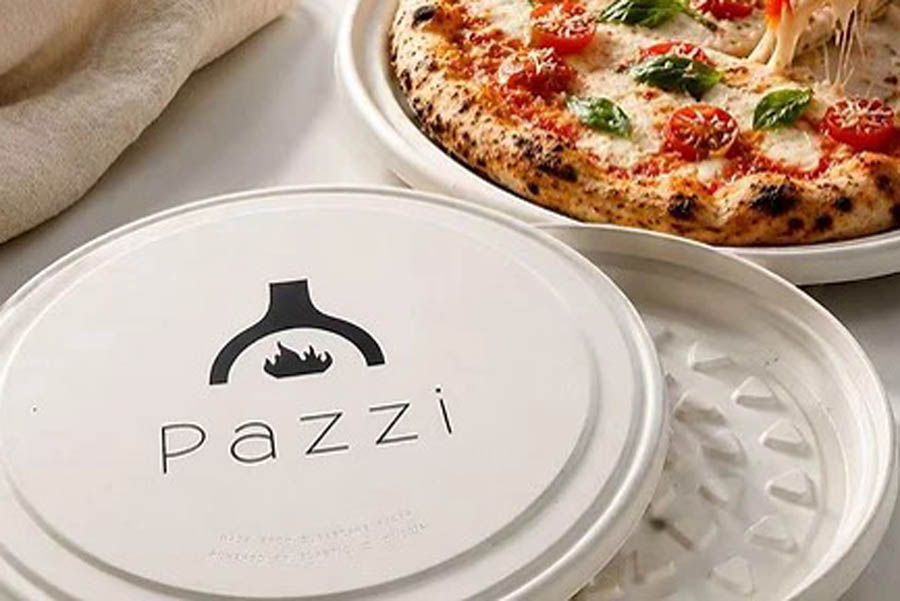
Blastiq is competing in the Packnorth Award with a pizza box made from PFAS-free, moulded bagasse – the renewable fibre left behind after sugar has been extracted from sugar cane. Bagasse is a pure plant fibre and does not itself contain PFAS. The challenge with pizza boxes lies instead in providing a barrier against grease and moisture, where conventional manufacturers have often used PFAS.
Blastiq has developed its own PHA-based coating, which is applied to the bagasse fibre to maintain its resistance to grease and moisture without introducing PFAS into the packaging. According to the company, the result provides the same functionality as a conventional pizza box, but without harmful chemicals, completely free from microplastics and fully compostable. The round shape is designed around the pizza itself, reducing material consumption and unnecessary packaging while also optimising storage and transport.
As the packaging is made from pure bagasse fibre, it can be recycled through paper recycling streams.
The packaging is a deliberate response to the EU’s phase-out of PFAS in food packaging, with pizza boxes being one of the product types most affected. The solution is already being supplied to customers in the food industry.
Packaging recyclability
The round pizza box has been developed to make disposal as simple as possible, without requiring consumers to think about how to separate different materials. It consists of moulded bagasse – a pure plant fibre – with Blastiq’s PHA-based PFAS-free coating as the sole barrier. It can be sorted through paper recycling streams.
Where conventional pizza boxes may combine board with PFAS treatments, making recycling more difficult and potentially contaminating fibre streams with greasy packaging, this solution uses a uniform, bio-based construction, according to Blastiq.
There are no layers to separate, no plastic window to remove and no mixed materials to complicate sorting. In other words, consumers do not need to separate anything. Because the fibre is pure and the coating is PFAS-free, the packaging is also compostable and breaks down into biomass rather than leaving behind microplastics. This also helps address the grease and food residues that normally make pizza boxes difficult to recycle.
Simplicity is the key point: packaging made from a clean, renewable material is easier to dispose of correctly – both for consumers and for waste management systems.
The proportion of conventionally recycled material, such as recycled plastic or recovered fibre, is therefore low or non-existent – a deliberate choice. The objective is not to recycle fossil-based materials, but to replace them entirely. Bagasse is renewable and compostable and breaks down into biomass after use, allowing it to return to the natural cycle.
n this sense, the packaging is circular through its renewable origin and biodegradability rather than through recycled content. After use, it can be processed through paper recycling streams.
Now is the time to enter Packnorth Award 2026. The jury will meet in September.
As a participant, your entry will be showcased at Sign Print & Pack in Odense, Denmark, in September, followed by Empack in Stockholm a few weeks later. In addition, all participating entries will be featured in Packnews issue 4 this year.
Don’t miss the opportunity to take part!